Artificial intelligence is changing how students learn, research, write assignments, and solve academic problems. With just a few prompts, students can receive explanations of difficult concepts, summaries of lengthy chapters, ideas for projects, and answers to questions that might otherwise require hours of research.
However, access to information does not automatically mean that students understand it or can trust it. AI tools can produce convincing explanations that contain factual errors, outdated information, misleading conclusions, or references that do not exist. Without the ability to verify these responses, students may unknowingly build their knowledge on inaccurate information.
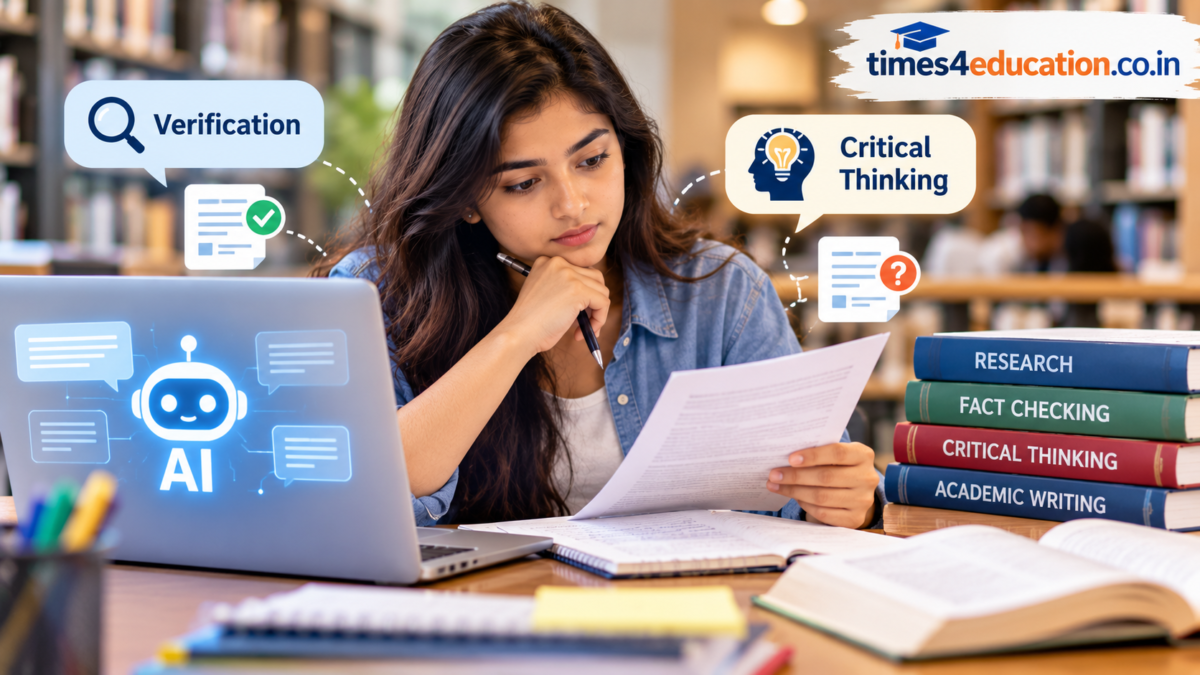
This is why AI literacy needs to go beyond teaching students how to operate AI tools. It must also develop verification skills, critical thinking, source evaluation, and the ability to make independent judgments. These skills help students use AI as a learning resource without surrendering responsibility for what they believe, write, or submit.
What Does AI Literacy Really Mean?
AI literacy refers to the knowledge and skills people need to understand, evaluate, and use artificial intelligence responsibly. It includes recognizing how AI systems work, understanding their limitations, identifying potential risks, and making informed decisions about when to use them.
For students, AI literacy involves more than knowing how to write effective prompts or generate answers quickly. It also means understanding that an AI-generated response is not necessarily accurate simply because it sounds confident.
A student who uses AI to understand a scientific concept should be able to compare the explanation with reliable learning materials. Someone using AI for a research assignment should know how to locate original studies, check references, and distinguish evidence from unsupported claims.
UNESCO’s AI Competency Framework for Students emphasizes critical judgment, ethical awareness, and an understanding of AI technologies. The framework encourages educational systems to prepare students to understand, apply, and creatively engage with AI rather than become passive users of automated systems.
Why Verification Is an Essential AI Skill
Verification is the process of checking whether information is accurate, relevant, current, and supported by credible evidence.
This skill becomes particularly important when students use generative AI for academic work. Such systems can produce answers that appear well organized and authoritative even when some details are incorrect.
AI can produce convincing but incorrect answers
Generative AI systems create responses based on patterns learned from data and other technical processes. They do not guarantee that every statement they produce is factually correct.
For example, a student preparing a history assignment might ask an AI tool for the date of an important event. The response could contain an incorrect date or confuse two related events.
Similarly, an AI assistant might explain a mathematical method correctly in one step but make an error in a later calculation.
Students should therefore treat AI responses as information to evaluate rather than conclusions that must automatically be accepted.
References and quotations need checking
Academic assignments often depend on trustworthy sources. AI tools may suggest publications, authors, quotations, or research findings that are incomplete, inaccurate, or entirely fabricated.
Before citing an AI-suggested source, students should confirm that the publication exists, examine the original material, and check whether it supports the statement being made.
A reference that looks academic is not necessarily reliable. Verification helps students maintain academic standards and avoid unintentionally submitting unsupported claims.
Information can become outdated
Some academic subjects change rapidly. Technology, medicine, environmental science, economics, and public policy may involve new evidence, revised recommendations, or changing regulations.
An AI response may not reflect the latest developments. Students researching current topics should consult recent publications and authoritative sources rather than assume that a generated answer represents the current state of knowledge.
How Critical Thinking Improves the Use of AI
Verification checks the reliability of information. Critical thinking goes further by examining its meaning, assumptions, evidence, and implications.
A student may confirm that a statistic is correct but still need to ask whether it is relevant to the argument. Likewise, a source may be genuine while presenting a limited perspective that requires comparison with other evidence.
Critical thinking helps students move beyond accepting or rejecting an answer and begin evaluating how well it supports a particular conclusion.
Question the reasoning behind an answer
Students should ask why an AI tool reached a particular conclusion and whether its explanation follows logically from the available evidence.
Useful questions include:
- What evidence supports this statement?
- Are there alternative explanations?
- Does the conclusion follow from the information provided?
- What assumptions does the answer make?
- What important details might be missing?
These questions encourage students to examine ideas rather than simply collect responses.
Recognize bias and missing perspectives
AI systems can reflect biases present in their training data, design, or the information supplied by users. As a result, responses may overlook certain communities, present one perspective too prominently, or reproduce misleading generalizations.
For example, a student researching a social issue might receive an explanation that focuses mainly on economic factors while overlooking historical or cultural influences.
Comparing multiple credible sources can reveal these gaps. Students should consider who produced the information, whose perspectives are represented, and what evidence might challenge the initial conclusion.
Distinguish explanation from understanding
An AI tool can explain a concept in simple language, but reading that explanation does not necessarily mean the student has mastered the subject.
A useful way to test understanding is to close the AI tool and explain the concept independently. Students can also solve a similar problem, apply the idea to a new situation, or answer follow-up questions without assistance.
If they cannot do so, they may need further study rather than another generated summary.
Practical Ways Students Can Verify AI-Generated Information
Students do not need advanced technical knowledge to develop effective verification habits. A consistent process can make AI-assisted learning more reliable.
1. Identify claims that need evidence
Begin by separating general explanations from claims that require confirmation. Statistics, dates, scientific findings, quotations, legal statements, and research references deserve particular attention.
Not every sentence requires the same level of checking, but important factual claims should never be accepted solely because an AI tool presents them confidently.
2. Consult authoritative sources
Use textbooks, official educational resources, peer-reviewed research, government publications, and recognized institutions when appropriate.
For example, students researching AI and education can consult UNESCO’s educational guidance and competency frameworks. Students studying a scientific topic may need to examine original research or established academic references.
The appropriate source depends on the subject and the claim being investigated.
3. Compare information across independent sources
When a claim is important or controversial, compare it with more than one credible source. Look for agreement, differences in interpretation, and evidence that may challenge the initial answer.
Simply finding the same statement repeated across several websites is not enough if those websites rely on the same original source.
The aim is to assess the quality and independence of the evidence, not merely count how many pages repeat a claim.
4. Open and read the original reference
If AI recommends a journal article, book, report, or official webpage, locate the original publication whenever possible.
Check whether the relevant passage actually supports the claim. Pay attention to the publication date, author qualifications, methodology, limitations, and context.
This habit is especially valuable for research papers, dissertations, and assignments that require formal citations.
5. Recheck calculations and technical explanations
For mathematics, statistics, coding, and science assignments, students should independently test important results.
They can repeat calculations, run code in an appropriate environment, compare solutions with course materials, or use a second method to check an answer.
A result that looks plausible is not necessarily correct. Independent testing helps reveal mistakes that may be difficult to notice in a polished explanation.
The Role of Teachers and Educational Institutions
Students need opportunities to practise verification and critical thinking as part of their regular education. These skills should not be left to individual experimentation with AI tools.
Teach verification as part of digital literacy
Schools and colleges can introduce exercises in which students evaluate AI-generated answers, identify unsupported claims, and locate reliable evidence.
For instance, a teacher could provide an AI-generated paragraph containing several factual errors and ask students to identify and correct them using trusted sources.
Such activities teach students that checking information is a normal part of academic work rather than an optional extra.
Redesign assignments to reward reasoning
Assignments should assess not only the final answer but also how students reached their conclusions.
Teachers can ask students to explain their methods, justify their source choices, compare competing arguments, or discuss how they revised an initial interpretation after examining new evidence.
These approaches make independent understanding more visible and encourage students to engage meaningfully with the subject.
Establish clear rules for AI use
Institutions should explain when AI assistance is permitted, when it must be disclosed, and which activities must be completed independently.
Students should understand the difference between using AI to explore a concept and submitting generated work in violation of assignment requirements.
Clear guidance helps students use AI responsibly without having to guess what their teachers expect.
Support teachers with practical training
Educators also need the knowledge and resources to evaluate AI-generated content, explain its limitations, and design appropriate learning activities.
Professional development can help teachers identify realistic classroom uses, establish consistent expectations, and encourage thoughtful discussion about accuracy, bias, privacy, and academic integrity.
Why These Skills Matter Beyond the Classroom
Verification and critical thinking are not limited to academic assignments. They are increasingly relevant to everyday decisions in a digital environment where AI-generated text, images, summaries, and recommendations are widely available.
Students may encounter AI-generated information while researching careers, comparing products, reading news, or evaluating financial and health-related claims.
The ability to question sources, identify unsupported conclusions, and recognize uncertainty helps them make better-informed decisions.
These skills can also support future employment. Workers in many fields need to evaluate digital information, check automated outputs, protect confidential data, and take responsibility for decisions influenced by technology.
The OECD’s 2026 AI literacy framework highlights the importance of helping primary and secondary students understand AI systems, evaluate their outputs critically, and use them ethically and creatively.
Developing these abilities during education can help prepare students for environments in which working with AI is increasingly common.
A Balanced Approach to AI-Assisted Learning
The objective of AI literacy should not be to discourage every use of artificial intelligence. AI can help students explore unfamiliar topics, receive additional explanations, organize their ideas, and practise difficult skills.
The challenge is to ensure that these benefits do not come at the expense of independent reasoning and intellectual curiosity.
A balanced approach encourages students to attempt problems themselves, use AI when it adds value, verify important information, and reflect on what they have learned.
For example, a student writing an assignment might use AI to generate possible research questions. The student can then select a suitable question, locate credible sources, evaluate competing evidence, develop an independent argument, and follow the institution’s rules on AI assistance.
In this process, AI supports the work without replacing the student’s responsibility for the final result.
Conclusion
AI literacy should include verification and critical thinking because the ability to generate an answer is not the same as the ability to determine whether that answer is correct.
Students need to recognize the limitations of AI-generated information, check important claims against credible sources, question assumptions, and develop their own understanding of academic subjects.
Schools, colleges, and universities can support this process through clear AI policies, practical verification exercises, and assessments that reward reasoning rather than simply the production of finished work.
As artificial intelligence becomes more integrated into education, these skills will become an important part of effective digital learning. The goal is not merely to help students use AI more efficiently, but to prepare them to evaluate information independently and make responsible decisions in an AI-supported world.